Last-mile delivery is often the only physical touchpoint between a mattress brand and its customer, especially for DTC brands. Five costly mistakes recur: treating haul-away as optional, underestimating in-home complexity, skipping pre-delivery communication, measuring delivery cost without failure cost, and choosing a “national” carrier that lacks national consistency. Each drives returns, refunds, and lost referrals.

You spent years perfecting your product. Your materials are sourced carefully, your comfort layers are engineered for sleep quality, and your brand promise is built on the idea that a great mattress changes lives. Then your last-mile mattress delivery team shows up late, refuses to haul away the old mattress, and leaves scuff marks on the bedroom wall.
The customer doesn’t blame the crew. They blame you.
Last-mile delivery is the final — and often the only — physical touchpoint between a mattress brand and its end customer. For DTC brands especially, there is no retail store experience, no showroom moment. The mattress delivery service is the brand experience. And when it goes wrong, the downstream costs — returns, refunds, negative reviews, lost referrals — can far outpace whatever you thought you were saving on logistics.
Here are the five most common last-mile mattress delivery mistakes, what each one is actually costing you, and what a high-performing white glove mattress delivery operation looks like in practice.
Mistake #1: Treating Haul-Away as an Optional Upgrade
Old mattress removal isn’t a nice-to-have feature of your mattress delivery service — it’s an expectation. The majority of customers purchasing a new mattress are replacing an old one, and they have no practical way to dispose of it on their own. When your delivery team refuses the haul-away, or simply forgets it was part of the order, you’ve created a problem the customer will remember long after the new mattress has broken in.
This is one of the top delivery complaints in the mattress industry, and it’s entirely preventable.
The Real Cost:
Negative reviews, refund requests, and customer service escalations. Mattress companies rely heavily on referrals and word of mouth. A single poor haul-away experience gets amplified publicly.
What It Should Look Like:
White glove mattress delivery with old mattress removal is built into every delivery. When this is locked into the service agreement from day one, the complaint category disappears.
Mistake #2: Underestimating the Complexity of In-Home Mattress Delivery
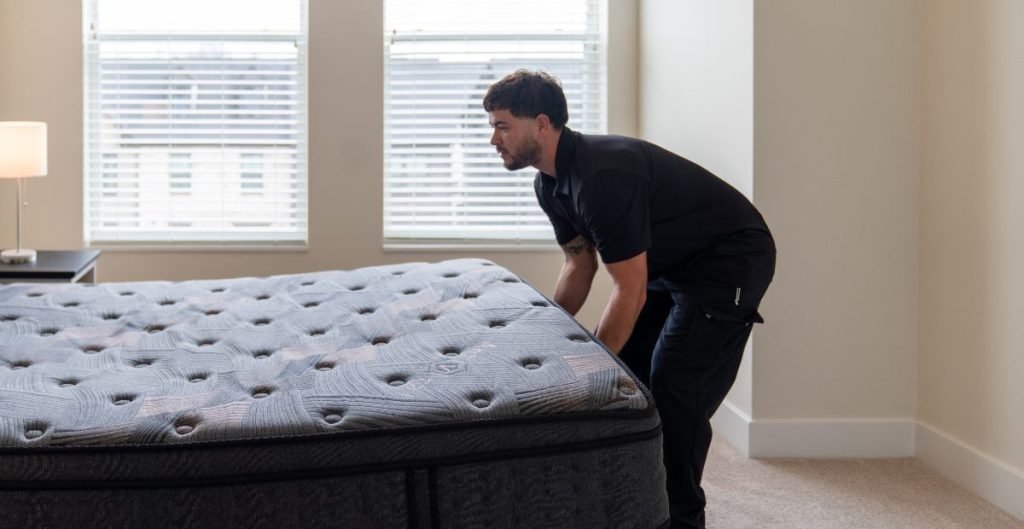
A mattress delivery is not a porch drop or a dock transfer. You are entering the most intimate space in someone’s home — their bedroom. The delivery team has to earn the customer’s trust in the first 30 seconds at the front door.
This creates specific operational demands that most standard carriers aren’t trained to meet:
- King and Cal King mattresses are exceptionally heavy and require trained two-person delivery crews — especially for second-floor deliveries where a single misstep damages walls, flooring, or the product itself.
- White glove setup means the mattress goes on the frame, in the room of choice. Not against a hallway wall.
- Driver professionalism inside the home directly reflects your brand. A dirty uniform or a mess left behind becomes a one-star review within the hour.
- Return and reverse logistics are a particular challenge in mattress delivery. When the right processes aren’t established upfront, returns become operationally chaotic and expensive.
The Real Cost:
Failed setups, property damage claims, and customer complaints that trace back to undertrained delivery teams. For mattress brands, the delivery team is often the only human face of your company the customer ever sees.
What It Should Look Like:
A mattress logistics provider with standardized SOPs across all markets and client-specific training programs. CDS Logistics, for example, develops custom handling protocols for individual mattress brands so every crew in every market performs to the same standard.
Mistake #3: Skipping Pre-Delivery Communication
Mattress delivery requires preparation on the customer’s end. They need to be home. They need to clear a path to the bedroom. They need to make decisions about existing furniture. Mattress deliveries require the end consumer to be present, prepared, and ready when delivery crews arrive at their door.
When a delivery arrives with no advance notice, or with a delivery window so vague it spans half the day, customers panic, miss the delivery entirely, or receive the crew unprepared. All three outcomes cost you.
The Real Cost:
Failed first-attempt deliveries, redelivery costs, and negative reviews about a communication failure that had nothing to do with your product. “I didn’t know they were coming” is one of the most preventable delivery complaints in the industry.
What It Should Look Like:
Technology-driven pre-delivery communication that puts the customer in control. Real-time order tracking on the day of delivery, pre-delivery survey confirmations, and self-scheduling portals that let customers choose their own delivery window eliminate the “I didn’t know” complaint entirely. The customer is informed and ready before the truck leaves the hub.
Mistake #4: Measuring Delivery Cost Without Measuring Delivery Failure Cost
Most operations teams measure logistics spend as a line item: cost per stop, cost per mile, cost per zone. What rarely gets measured — but often hurts far more — is the true downstream cost of a mattress delivery that goes wrong.
Mattress companies rely heavily on referrals and word of mouth. People spend roughly a third of their lives sleeping, and when they find a mattress they love, they tell people. When the delivery experience fails, they also tell people — loudly, publicly, and in detail.
The full cost of a single failed white glove mattress delivery includes:
- Return shipping and redelivery logistics
- Full or partial refund on the order
- Customer service labor spent managing the complaint
- A public negative review influencing future purchase decisions
- Lost referral revenue from a customer who will never recommend your brand
- Brand damage that accumulates with every repeat failure
The Real Cost:
Frequently far greater than any per-stop savings from choosing a lower-cost carrier. The math only looks favorable if you’re not accounting for failure.
What It Should Look Like:
A mattress 3PL that tracks post-delivery customer satisfaction scores and uses real performance data to identify and correct issues before they compound. Verified CDS metrics across mattress accounts: 4.9/5 customer satisfaction score (CDET), 99% on-time delivery rate, and a damage rate under 1%.

Mistake #5: Choosing a “National” Carrier Without National Consistency
A carrier that performs well in the Mid-Atlantic and falls apart in the Midwest isn’t a national mattress logistics provider — it’s a regional carrier with a national brochure. Mattress brands that sell across the country need the same white glove delivery standards, the same setup execution, and the same customer communication protocols in every market.
When delivery quality varies by region, your brand takes the hit regardless of where the failure happened. A customer in Phoenix doesn’t care that your Mid-Atlantic operation runs perfectly.
The Real Cost:
Regional spikes in complaints, inconsistent customer experiences that undermine your brand’s national positioning, and the operational burden of managing multiple regional providers to fill coverage gaps.
What It Should Look Like:
The same SOPs, training standards, and customer communication protocols operating across every hub in the network. CDS runs the same playbook across 182 hubs nationwide. A mattress brand expanding into a new region doesn’t rebuild its delivery model — it simply expands.
What a High-Performing Last-Mile Mattress Delivery Program Delivers
A strong white glove mattress delivery partner isn’t just moving product. They’re protecting your brand at every doorstep. The performance benchmarks a mattress logistics provider should be able to demonstrate:
- 99% on-time delivery rate across all markets
- Damage rate under 1% — consistently maintained
- White glove setup and old mattress haul-away as standard on every delivery
- Proactive pre-delivery communication that eliminates missed-appointment complaints
- Post-delivery customer satisfaction measurement with data shared back to your operations team
- Trained two-person crews with client-specific handling protocols
- Nationwide network operating from a single, consistent playbook
These aren’t premium service tier features. They’re the baseline for protecting your brand at scale.
Frequently Asked Questions About Mattress Last-Mile Delivery
What is white glove mattress delivery?
White glove mattress delivery means a trained two-person crew delivers the mattress to the room of choice, sets it up on the frame, and removes the customer’s old mattress. It goes well beyond leaving a package at the door. For most mattress brands, white glove delivery is the standard — not an upgrade — because it’s the only delivery model that matches the in-home nature of the product.
What does a mattress logistics provider do?
A mattress logistics provider manages the warehousing, fulfillment, and final-mile delivery of mattresses from manufacturer or DTC brand to end customer. The best mattress 3PL partners handle the full cycle: integrated warehousing, order management, two-person white glove delivery, old mattress haul-away, and post-delivery customer satisfaction tracking.
How do I reduce mattress delivery damage rates?
Mattress damage rates are reduced through trained two-person delivery crews, standardized handling SOPs, and proper equipment at every hub. The industry benchmark is under 1% damage rate. Choosing a mattress delivery partner with client-specific training protocols and consistent SOPs across all markets is the most reliable way to maintain that standard at scale.
What is the typical sales cycle for switching mattress delivery providers?
The mattress delivery sales cycle is typically 2–3 months from initial conversation to launch — significantly faster than other big and bulky verticals like millwork (8–18 months) or cabinets (6–12 months). Onboarding a new mattress company is operationally straightforward, which means brands in growth mode or experiencing service failures can move quickly when they’re ready to switch.
Is old mattress haul-away included in standard delivery?
Not every provider includes it by default. Here at CDS Logistics, haul-away is not included in standard delivery to account for the extra level of care and service provided, but it’s a service that customers praise and find immense worth in.
Ready to Fix Your Last-Mile Mattress Delivery Program?
CDS Logistics is a national mattress logistics provider with 182 hubs, 35+ years of big and bulky delivery experience, and verified performance metrics across mattress accounts. If your current delivery program has gaps you’ve been meaning to fix, let’s talk.

