Window and door manufacturers running general-freight or standard-LTL delivery commonly see damage rates between 1 and 3 percent, while operations built specifically for millwork run under 1 percent. Cutting damage claims in half comes down to these five operational changes.
Most window and door manufacturers treat damage as a cost of doing business. A unit cracks in transit, a claim gets filed, a replacement ships, and everyone moves on. The number on the monthly damage report looks manageable, so it never rises to the level of a strategic problem.
That framing is the problem. The reported claim is only the visible portion of what damage actually costs, and the gap between a typical millwork operation and a best-in-class one is wider than most operations leaders realize.
Manufacturers running general-freight or standard-LTL delivery commonly see millwork damage rates between 1 and 3 percent. Operations built specifically for windows and doors run under 1 percent. On the surface that spread looks small. Across tens of thousands of units a year, it is the difference between a damage problem that compounds across your builder relationships and one that quietly disappears.
Here is what actually separates the two, and the five changes that close the gap.
Download Inside a Sub-1% Millwork Operation >>
How to Cut Window and Door Damage Claims in Half
1. Put two trained people on every delivery
Single-driver delivery models, including most gig-driver platforms, are structurally incapable of handling millwork without elevated damage rates. A glass-heavy unit has to be handled vertically. A long-profile patio door needs coordinated lifting. One person physically cannot manage that safely, so corners get cut and units get damaged.
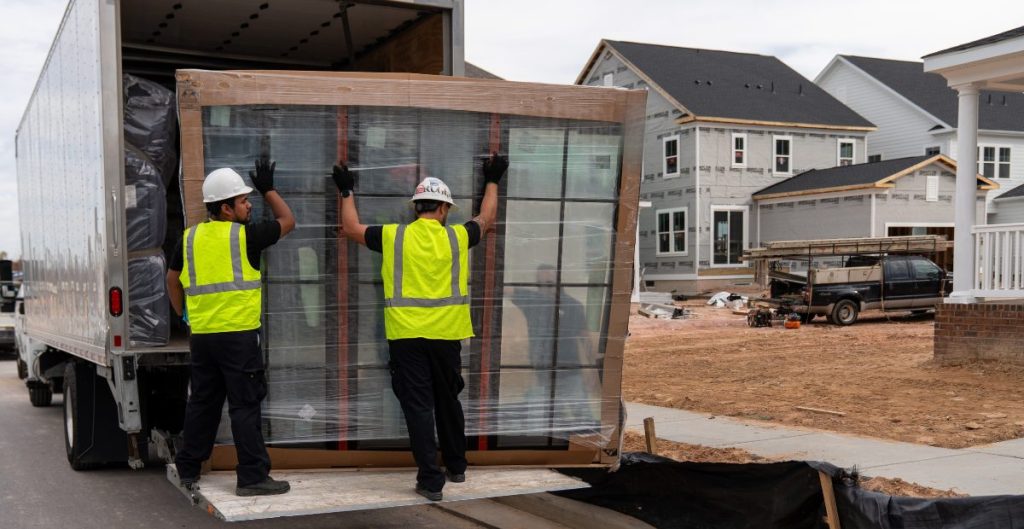
A two-person trained crew changes the math. One person stages and protects the unit while the other navigates placement. One manages documentation while the other handles the physical work. Both are available for the vertical handling that glass-heavy units demand. This is the single highest-impact change a manufacturer can make, and it is also the one generic carriers are least equipped to offer.
2. Train and certify for millwork specifically, not freight generally
A cabinet isn’t a window. A window isn’t a patio door. The handling protocols that work for general big and bulky freight don’t translate to millwork, and a driver who delivers furniture one day and windows the next has no reason to know the difference.
Millwork-specific certification covers the things that actually drive damage: glass handling protocols, long-profile unit handling, load sequencing for jobsite delivery, and jobsite navigation around framing, mud, and active construction. The point isn’t compliance. It’s consistency. A window delivered in Tampa should be handled exactly the way it’s handled in Pittsburgh. That consistency is what produces a national damage rate instead of regional variance.
3. Track every unit at every touchpoint
When a window arrives damaged, the manufacturer, dealer, and builder all want the same thing: to know exactly when, where, and how it happened. Without that data, every claim is a dispute. With it, claims become root-cause conversations, and the same damage modes stop repeating.
That requires scan-based chain of custody at every critical touchpoint, from manufacturer pickup through hub receipt, outbound load, jobsite arrival, and final placement, with photo documentation at loading, arrival, and placement. Shipment-level tracking through a standard carrier platform isn’t enough. If you can’t pinpoint the touchpoint where damage occurred, you can’t prevent it from happening again.
4. Cut the number of touchpoints
Every additional handoff is another opportunity for damage. A unit that moves through multiple LTL transfers and third-party last mile subcontractors is handled more times, by more people, with less accountability at each step. Networks that consolidate millwork handling across a single operating model produce lower damage rates than networks that scale through subcontractors. Fewer hands on the glass means fewer claims.
5. Give drivers authority at the jobsite
The single biggest predictor of jobsite damage isn’t the driver’s training. It’s whether the driver has the authority to make decisions when conditions don’t match the plan.
When a jobsite isn’t ready, the trained option is to protect the unit, document the condition, communicate with the builder, and reschedule cleanly. The untrained option is to leave it on the driveway and drive away. The first protects your damage rate and your builder relationship. The second is how a 1 percent operation becomes a 3 percent operation.
What sub-1% actually delivers
CDS Logistics runs under 1 percent damage on millwork deliveries across millions of windows and doors delivered annually, with a 99% on-time rate and a 4.9/5 customer satisfaction score, supported by 35+ years of millwork focus and 182 hubs nationwide. The number that matters most isn’t any single one of those. It’s that they hold steady in every market, because the operating model is the same everywhere.
Cutting your damage claims in half isn’t a matter of finding a better driver or negotiating a better claims process. It’s a different operating model, one built for windows and doors rather than retrofitted from general freight.
If you want to see exactly what that model looks like in practice, our guide Inside a Sub-1% Millwork Operation breaks down the crews, the technology, and the jobsite protocols that produce these numbers.
Or get a free Windows & Doors Logistics Assessment and see where your operation sits against industry leaders.
Related resources:

