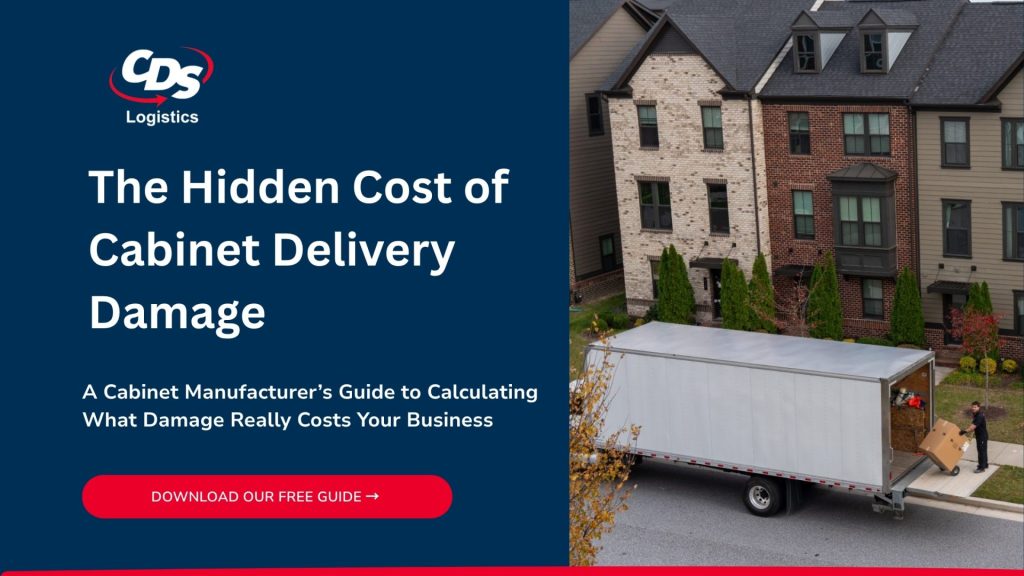
Cabinets aren’t more fragile than other big and bulky products handled at sub-1% damage rates — the difference is the operating model, not the product. Five root causes keep general-freight carriers stuck at 3-5% damage rates: generic handling protocols, multi-box order coordination failures, inadequate driver training, high touchpoint counts, and lack of scan-based accountability data.
If you’ve ever asked your delivery partner why your cabinet damage rate is what it is, you’ve probably gotten the same answer most cabinet manufacturers get: “Cabinets are fragile.”
That’s true, but it’s not the whole story. Cabinets are no more fragile than millwork, glass-heavy patio doors, large appliances, or oversized furniture, all of which are handled by specialist last mile operations at damage rates under 1%. The difference between a 3 to 5% damage rate and a sub-1% damage rate isn’t fragility. It’s the operating model.
Five root causes separate cabinet-capable delivery operations from generic 3PLs. If you’re seeing damage rates above 1% on cabinets, one or more of these is almost certainly the reason.
Five Reasons Your Cabinet Damage Rate Won’t Drop Below 1%
1. Generic handling protocols
A cabinet isn’t an appliance. It isn’t a mattress. It isn’t a piece of furniture. The corner protection, lifting techniques, finish protection, and stacking rules that work for general big and bulky freight don’t translate to cabinet handling.
A wall cabinet has different structural weak points than a base cabinet. A face frame cracks if lifted incorrectly. A finished door scratches against a tool belt or a glove with a stray staple. Cabinet stacking has rules that aren’t intuitive to drivers who handle mattresses on Tuesday and treadmills on Wednesday.
Delivery partners who treat all big and bulky products the same will produce 3 to 5% damage rates by default. Not because they don’t try. Because the protocols they use aren’t designed for cabinet construction.
2. Multi-box order coordination failures
Most cabinet orders involve 10 to 20 or more boxes that have to arrive together. A typical kitchen install isn’t complete until every wall cabinet, every base cabinet, every filler, every toe-kick, and every accessory shows up at the jobsite.
When the system loses track of one box, the entire order is held. Or worse, delivered incomplete, and the missing piece is later flagged as “damage” because the homeowner can’t complete the install.
Multi-box order management requires purpose-built tracking, not a generic shipment-level system. If your delivery partner can tell you that an order shipped but can’t tell you which specific cabinets are at which specific touchpoint in the network at any given moment, you have a multi-box coordination problem regardless of what your damage rate says.
3. Inadequate driver training
A cabinet driver needs to know how to lift a wall cabinet vs. a base cabinet. Where the structural weak points are on a face frame. How to protect a finish from gloves, tools, and door frames. How to navigate a finished home or active jobsite without scuffing walls or floors.
This isn’t knowledge a generic last mile driver has. It comes from cabinet-specific training programs, certification, and ongoing reinforcement. Operations that run sub-1% damage rates have a structured driver training curriculum that covers cabinet handling specifically, with documented certification and ongoing performance tracking.
Operations that don’t run a cabinet-specific training program will produce 3 to 5% damage rates regardless of how careful individual drivers try to be.
4. Touchpoint count
Every additional touchpoint in the delivery chain, every transfer, every re-load, every cross-dock, is another opportunity for damage. A cabinet handled five times has roughly five times the damage exposure of a cabinet handled once.
Hub-and-spoke networks with consolidated cabinet handling at every stage produce significantly lower damage rates than networks where cabinet orders move through multiple hand-offs across third-party carriers. The economics of cabinet damage favor minimizing touchpoints, even if that means a slightly longer transit time on some lanes.
If your delivery partner uses subcontractors, regional carriers, or third-party LTL connections to complete cabinet deliveries, your damage rate has a structural floor that no amount of driver training can move below.
For a full cost breakdown, download our guide >>
5. Lack of accountability data
When damage happens, can you trace exactly when, where, and how it happened?
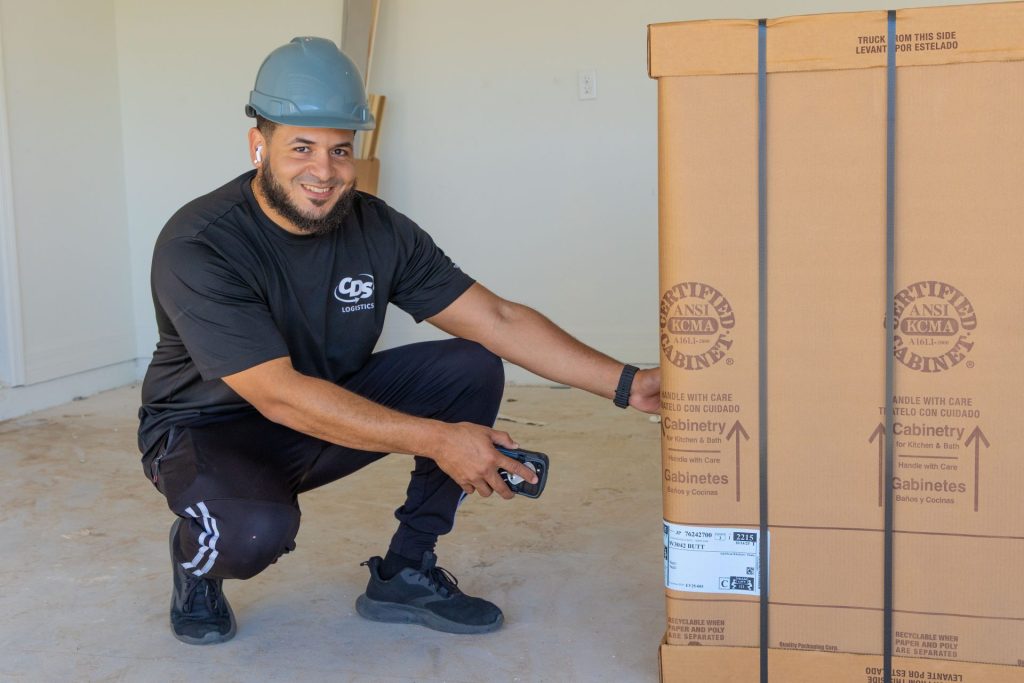
Most cabinet manufacturers can’t. They get a damage claim, a photo, and a credit. They don’t get a chain-of-custody timeline that shows the cabinet was scanned and photographed at the manufacturer dock, at the regional hub, on the outbound truck, on arrival at the delivery site, and at final placement.
Without point-of-scan data at every critical touchpoint, root-cause analysis is impossible. Which means the same damage modes repeat indefinitely. The cabinet that gets cracked during outbound loading this month will get cracked the same way next month, because no one can prove that’s where it happened.
Accountability data isn’t just a claims-resolution feature. It’s the prerequisite for sub-1% damage performance, because you can’t fix what you can’t trace.
What sub-1% damage operations actually look like
Operations that consistently run under 1% damage on cabinets share an operational profile that addresses all five of these causes. Cabinet-specific driver training and certification. Two-person crews with white-glove protocols. Multi-box order management with box-level scanning at every touchpoint. National coverage with consolidated cabinet handling, not third-party hand-offs. Real-time tracking and photo documentation that produces a complete chain-of-custody timeline for every order.
This isn’t a single feature you can add to a generic carrier. It’s a different operating model.
Evaluate your current operation
We’ve built a vendor evaluation checklist, plus a complete cost framework and a five-step worksheet for calculating your true damage cost, into a free downloadable guide for cabinet manufacturers.
The vendor checklist alone is worth running against your current partner before your next renewal conversation.
Related posts:
- How Technology Is Transforming Cabinet Last Mile Delivery
- 3 Distribution Questions Every Cabinet Manufacturer Should Ask Their 3PL
- Strategic Logistics Planning for Cabinet Manufacturers: Decoupling Growth from Freight Market Chaos