White-glove delivery cuts fitness equipment damage claims by eliminating where damage occurs. Trained two-person teams move heavy treadmills and racks safely up or down stairs, protect the home, place and assemble the unit on site, and capture photo proof of delivery, ultimately reducing damaged units, returns, and disputed claims.
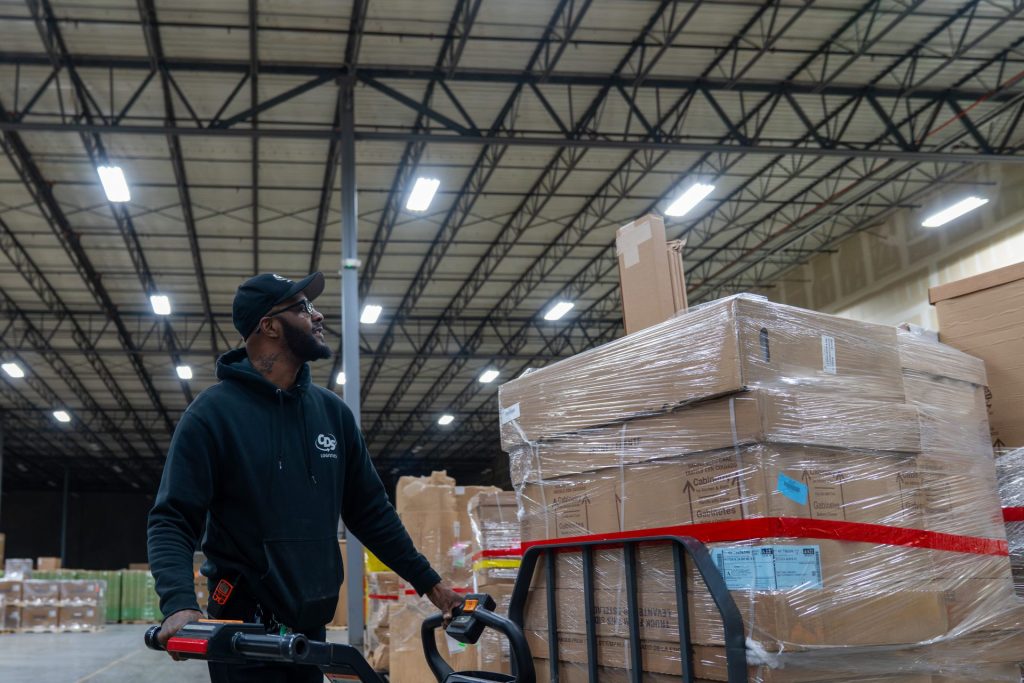
White glove delivery reduces damage claims on fitness equipment by limiting product handoffs to a single trained crew, using equipment-specific handling protocols (not generic furniture or appliance procedures), and completing assembly and placement on-site instead of leaving boxed units for the customer to move and build. For heavy, awkwardly balanced products like treadmills, home gyms, and smart bikes, fewer touchpoints and trained handling directly translate to fewer damage claims, returns, and one-star reviews.
Fitness equipment is some of the hardest freight in the big and bulky category to move without damage. A treadmill isn’t just heavy. It’s heavy and top-loaded, with a console that cracks if it’s tipped wrong and a deck that flexes under uneven lifting. A smart bike has a carbon-sensitive frame and an electronics console riding on top of it. Home gyms arrive in multiple boxes that must converge at the customer’s door, in the right order, undamaged, or the whole delivery fails. None of that matches the handling profile of a sofa or a refrigerator, but a lot of fitness brands end up shipped like one.
We’ve made this resource to break down how exactly white glove delivery lowers the amount of damage claims for big and bulky fitness equipment.
White glove delivery reduces damage claims on fitness equipment by limiting product handoffs to a single trained crew, using equipment-specific handling protocols (not generic furniture or appliance procedures), and completing assembly and placement on-site instead of leaving boxed units for the customer to move and build. For heavy, awkwardly balanced products like treadmills, home gyms, and smart bikes, fewer touchpoints and trained handling directly translate to fewer damage claims, returns, and one-star reviews.
Fitness equipment is some of the hardest freight in the big and bulky category to move without damage. A treadmill isn’t just heavy. It’s heavy and top-loaded, with a console that cracks if it’s tipped wrong and a deck that flexes under uneven lifting. A smart bike has a carbon-sensitive frame and an electronics console riding on top of it. Home gyms arrive in multiple boxes that must converge at the customer’s door, in the right order, undamaged, or the whole delivery fails. None of that matches the handling profile of a sofa or a refrigerator, but a lot of fitness brands end up shipped like one.
We’ve made this resource to break down how exactly white glove delivery lowers the amount of damage claims for big and bulky fitness equipment.
Why Fitness Equipment Damage Rates Run High
Most damage in this category doesn’t happen because a box gets dropped. It happens earlier, in decisions made before the driver ever reaches the door:
- Generic handling protocols. A carrier that treats a treadmill like a piece of furniture will lift, stack, and brace it like furniture.
- Too many touchpoints. Every transfer between a first-mile carrier, a regional cross-dock, and a final-mile subcontractor is another chance for a scratch, a crack, or a lost component. A treadmill handled four or five times before it reaches the customer carries roughly four or five times the damage exposure of one handled by a single dedicated crew.
- Parcel and LTL networks built for boxes, not equipment. Standard freight networks are optimized for speed and volume, not for the specific weak points of a folding treadmill hinge or an elliptical stride arm.
- No accountability at the point of handoff. Without scan-based tracking and condition checks at each stage, it’s nearly impossible to identify where damage occurred — so brands end up eating the cost of a claim they can’t even diagnose.
If your delivery partner relies on subcontracted regional carriers or general LTL to complete fitness equipment deliveries, your damage rate is more likely to be higher overall.
What White-Glove Delivery Actually Changes
White-glove delivery isn’t a premium add-on for the sake of a better unboxing experience; it changes the physical handling chain in ways that directly reduce damage:
Single crew, start to finish. A trained two- or three-person team receives the product, transports it, and completes setup in the home. That’s one handoff instead of several, and one crew accountable for condition at every stage rather than a chain of carriers pointing at each other after a claim.
Equipment-specific handling training. Just as cabinet crews learn corner protection and face-frame lifting, fitness equipment crews are trained on the failure points specific to the category: how to tilt and carry a treadmill without stressing the console mount, how to stage multi-box home gym orders so components arrive matched, how to handle a smart bike frame without torquing it against its own weight.
In-home assembly instead of curb delivery. A boxed treadmill that a customer must unpack, carry downstairs, and assemble themselves introduces damage risk after delivery — risk that shows up as a return or a bad review, not a carrier claim, but that still hits the brand. White-glove crews complete assembly and placement on-site, which removes that risk from the customer’s hands entirely.
Condition documentation at delivery. Photos and condition sign-off at the point of setup close the gap between “delivered” and “delivered undamaged and working.” That distinction matters more for fitness equipment than most categories, because a treadmill can look fine in the box and still have a damaged belt or a mis-calibrated console that only shows up once it’s assembled and powered on.
The Real Cost of Getting This Wrong
A damaged treadmill or smart bike rarely ends as a simple replacement part. It typically becomes a full return: a reverse pickup, a refund, a lost sale, and a public review that costs future sales. For DTC fitness brands competing on unboxing experience and customer trust, a damaged or poorly set-up delivery undoes the value proposition the product was sold on in the first place.
What to Look for in a Fitness Equipment Delivery Partner
Not every provider labeled “white glove” runs the same operation. Brands evaluating a partner for treadmills, home gyms, or connected fitness equipment should ask:
- Does the crew that receives the product also deliver and assemble it, or does it change hands along the way?
- Is training specific to fitness equipment, or adapted from furniture and appliance protocols?
- Is there scan-based tracking and condition documentation at each stage, so damage can be traced if it happens?
- Does the delivery include full setup and haul-away of packaging, or does the customer finish the job?
Those four answers separate a delivery partner built for this category from a generalist that happens to also deliver treadmills.
How CDS Logistics approaches it: CDS delivery teams are certified and uniformed, trained on the handling profile specific to each big and bulky category we serve — including fitness equipment — and supported by CDS Vision Suite™ for real-time tracking and condition visibility from pickup to final placement. With 180+ hubs across 48 states and a 4.9 out of 5 customer experience score, we build delivery networks designed to protect the product and the brand behind it.
Talk to an Expert to see how a dedicated fitness equipment delivery program can lower your damage rate.
Frequently Asked Questions
What is white-glove delivery for fitness equipment?
White-glove delivery means a trained crew delivers, assembles, and places the equipment in the customer’s home, then removes the packaging — as opposed to curbside or threshold delivery, where the customer handles unpacking and assembly themselves.
Does white-glove delivery cost more than standard shipping?
Yes, but the cost is typically offset by lower damage claims, fewer returns, and reduced customer service overhead — plus the reviews and repeat purchases that come from a positive delivery experience.
What is normal damage rate for treadmill or home gym deliveries?
Generalist carriers handling fitness equipment alongside other big and bulky freight often run in the 3-5% damage range. Delivery partners with category-specific training and single-crew handling can bring that below 1%.
About CDS Logistics: Experts in Big and Bulky Last Mile Delivery
CDS Logistics is one of the largest providers of last mile delivery and fulfillment solutions in the United States. CDS’s headquarters is in Baltimore, Maryland, with 182 hubs nationwide. Over the past three decades, CDS has built expertise to make the company an industry leader specializing in big and bulky products. CDS’s proprietary, in-house technology and hands-on operational expertise provide results that are consistent, reliable, and proven to drive outstanding customer experiences.
Click the buttons below to learn more about the industries we serve, as well as the services we provide.
- How White-Glove Delivery Reduces Damage Claims on Heavy Fitness Equipment
- How Route Optimization Software Actually Cuts Delivery Costs
- In-Home Delivery vs. Threshold Delivery vs. Curbside: What’s the Difference?
- Jobsite Coordination: Why Builder Schedules Should Drive Your Delivery Windows
- How Window and Door Manufacturers Can Cut Damage Claims in Half

