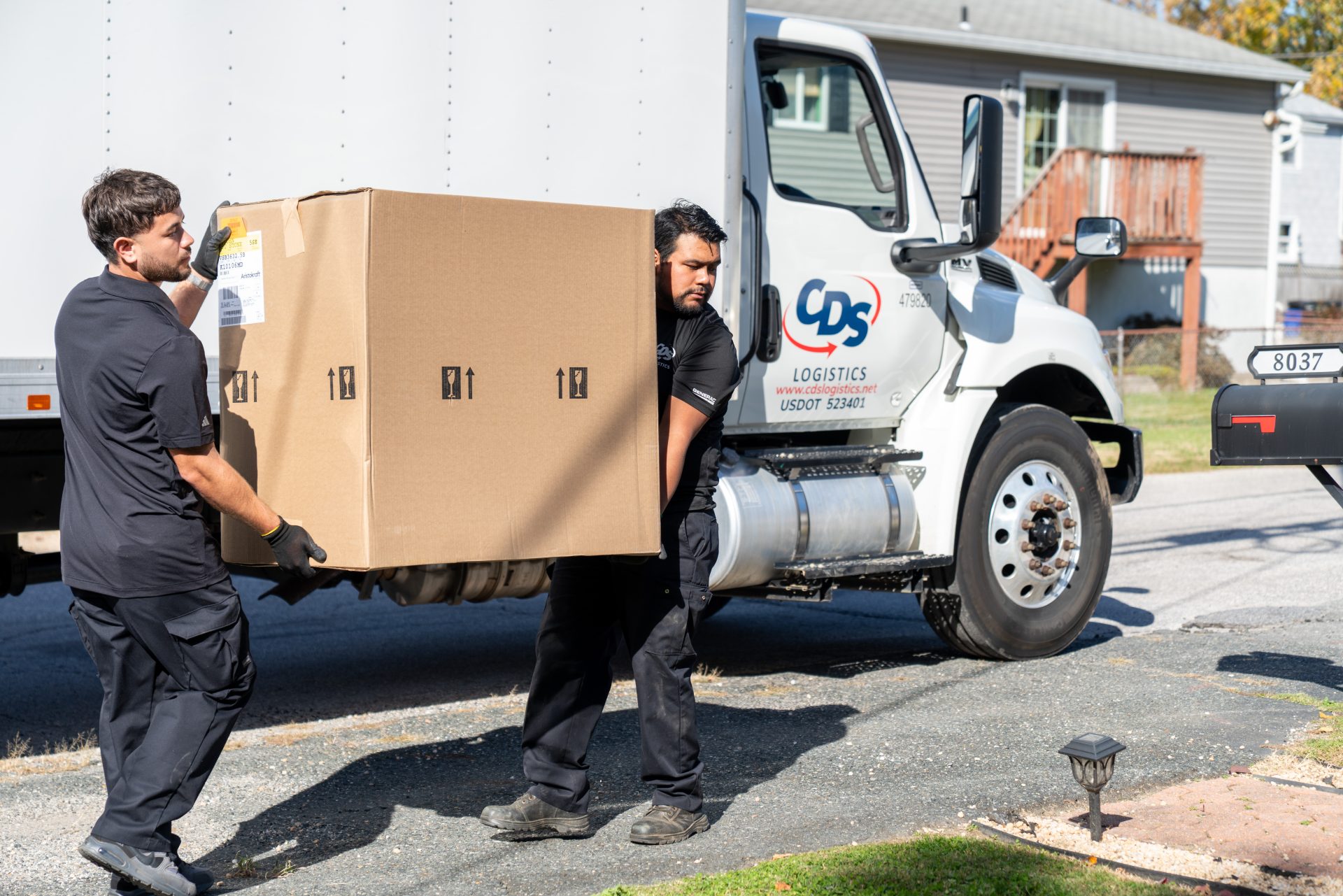
Two-person team delivery assigns two trained crew members to a single stop instead of one driver. For the products that define the big and bulky world — including cabinets and millwork, furniture, appliances, and fitness equipment — it is often the only way to get freight into the customer’s home intact, placed correctly, and accepted on the first attempt. It costs more than single-person delivery, but on the wrong freight, single-person delivery costs far more.
Picture two very different stops on the same route. During the first stop, a driver wheels a small flat-pack nightstand to the porch, captures a signature, and leaves in less than five minutes. At the second, the truck is carrying a treadmill bound for a basement gym, a French-door refrigerator that must clear a 34-inch doorway, and a kitchen’s worth of finished cabinets a contractor them. One of those is a one-person job. The other three are not.
That gap is what two-person team delivery exists to close. For anyone shipping cabinets, furniture, appliances, or fitness equipment, deciding which stops need a team — and understanding what that service costs — is one of the highest-leverage decisions in the final mile. Get it right and the product arrives undamaged, on time, and set up the way the customer expects. Get it wrong and you are paying for returns, redeliveries, injury claims, and a doorstep experience that undoes everything your brand promised at checkout.
This blog post covers when and why two-person teams are necessary, especially how they pertain to cost.
What is two-person team delivery?
Two-person team delivery is a final mile service level where two crew members arrive together to handle a single delivery. Instead of a lone driver leaving an item at the curb, a team can carry heavy freight up a flight of stairs, ease a sofa around a tight landing, place an appliance exactly where it belongs, and, depending on the service tier, unpack it, assemble or install it, and haul away the packaging and the old unit. It is the backbone of the higher-touch service levels most premium big and bulky brands sell:
| Service Level | Crew | What’s Included |
| Curbside | 1 person (often) | Item left at the curb or driveway |
| Threshold | 1-2 people | Item brought just inside the first dry, secure space (garage, entryway) |
| Room of Choice | 2 people | Item carried to the room the customer chooses, including upstairs |
| White Glove | 2 people | Room of choice plus unpacking, assembly/installation, and debris/haul-away |
When do you need it? It depends on what you ship
Cabinets and millwork
With cabinets, a single scuffed door panel or cracked corner doesn’t just mean a damaged box. It means a reorder, a delayed install, and a general contractor whose crew is now standing around waiting, increasing overall costs by the day. Cabinet runs are heavy, they’re often long and awkward to carry, and they frequently arrive at a job site ahead of the installers, which means they must be brought inside, staged in the right sequence, and protected, not dropped in a garage. A two-person team keeps large sections level and unmarked through doorways and upstairs, and gets them positioned so the trade that follows can start immediately. On finished millwork, the labor premium is almost always cheaper than a single reorder.
Furniture
Furniture is where the delivery becomes the unboxing moment. Sectionals, sleeper sofas, and dining tables are heavy, unbalanced, and famously unforgiving of tight apartment stairwells and 90-degree landings. A lone driver forced to maneuver a sofa alone is how property is damaged, and customers are left unhappy. Two people move the piece with control, protect the home on the way in, and place it where the customer specifically wants it. For a category sold on how it looks and feels in the room, the handoff is part of the product.
Appliances
Appliances combine everything that makes delivery hard: serious weight, real fragility, and a connection at the end. A French-door refrigerator or front-load washer can run 250 to 350-plus pounds, must clear doorways and navigate to a specific spot, and then needs to be leveled and hooked up — with the old unit disconnected and hauled away. None of that is safe or realistic for one person, and a botched appliance delivery tends to fail loudly: a fridge that won’t fit through the door, water lines left unconnected, a scratched panel on a $3,000 range. A trained two-person team handles the clearance check, the placement, the basic hookup, and the removal in a single visit.
Fitness equipment
Fitness equipment is the heavyweight of the group, and it almost always heads for the least accessible room in the house. Treadmills, smart home gyms, and power racks routinely top 300 pounds and end up in a basement or a third-floor walk-up, then need assembly on site. This is the category most likely to injure a solo driver or destroy a stairwell, and the one where customers most expect the item built and ready to use when the truck pulls away. Two people, the right equipment, and on-site assembly turn a dreaded delivery into the reason the customer recommends the brand.
The through-line across all four: if the item can’t be moved safely, placed correctly, and set up in a single trip by one person, it needs a team. For most cabinet, furniture, appliance, and fitness shippers, that describes most of their catalog.
What does two-person team delivery cost?
There is no single sticker price. Two-person delivery is quoted against your freight profile, your geography, the service level you sell, and your volume — a program built around 400-pound treadmills with basement assembly prices very differently from one moving flat-packed furniture to suburban ground floors. What you can pin down are the drivers behind the number:
| Cost Driver | Why it raises the price |
| Labor | Two trained crew members instead of one — the single biggest factor. |
| Service time per step | Placement, assembly, and installation take far longer than a drop, lowering stops per route. |
| Vehicle & equipment | Larger trucks, liftgates, dollies, straps, and blankets for heavy, finished goods. |
| Access difficulty | Stairs, long carries, and tight spaces — the basement treadmill, the third-floor sofa. |
| Add-on services | Assembly, appliance hookup, packaging removal, and haul-away of the old unit. |
| Route density | Sparse or low-volume routes spread fixed costs across fewer stops. |
| Accessorials & surcharge | Fuel, residential access, wait time, and redelivery on failed attempts. |
The last mile is already the most expensive leg of the supply chain. Two-person service adds to the per-stop cost on top of that, mostly through labor, and the lower stop counts that come with longer service times.
The cost that matters more: getting it wrong
Putting a single driver on a stop that needs two doesn’t save money: it defers and multiplies it, and the bill is different for every category. A damaged cabinet is a reorder and a stalled job site. A dropped sectional is a return, a replacement, and reverse logistics. Weighed against those outcomes, two-person delivery on the right freight isn’t a premium — it’s loss prevention. (We break the full picture down in The Hidden Costs of Shipping Big and Bulky Items.)
How to keep two-person delivery affordable
You don’t control the cost by pulling crews off freight that needs them: you control it by running the model well. That starts with clear rules for which SKUs require a team, so a lightweight accessory never rides on a two-person rate. It depends heavily on route density: a partner with an established nationwide hub network can cluster your stops, so each crew completes more deliveries per route, and your cost per stop falls. Tight appointment windows and proactive customer notifications cut failed first attempts — the most expensive avoidable cost in the last mile — while real-time tracking and photo proof of delivery reduce the damage disputes that hit finished cabinets and premium furniture hardest. Above all, it means working with a big-and-bulky specialist rather than a generalist parcel carrier: teams trained for team lifts, appliance hookups, and room-of-choice placement deliver the service at a lower true cost than crews improvising it.
Is it worth it?
For cabinets, furniture, appliances, and fitness equipment, the answer is almost always yes — because these products need more care to reach the right room, intact and on the first attempt, with one person. The labor premium is real, but it is consistently smaller than the combined cost of damage, returns, redeliveries, injuries, and lost customers that single-person delivery produces on freight that was never suited to it. The winning strategy isn’t more service everywhere. It’s precision: the right crew, on the right item, to the right room, the first time.
Frequently asked questions
Which products usually require two-person delivery?
Cabinets and millwork, furniture, major appliances, and fitness equipment are the core categories. They tend to be heavy, oversized or awkward, easily damaged, and destined for a specific room — all of which make a single-person drop impractical or risky.
What weight requires a two-person delivery team?
There is no universal legal limit, but many operations use a threshold of around 50–75 lbs. NIOSH’s recommended weight limit for a single lifter under ideal conditions is about 51 lbs — and far lower for bulky or awkward items, or when stairs and long carries are involved, which is why most furniture, appliances, and fitness equipment clear that bar easily.
Is two-person delivery the same as white glove?
Not quite. White glove uses a two-person crew and adds unpacking, assembly or installation, and debris removal. Room-of-choice delivery also uses two people but typically stops at placing the item in the chosen room.
Does two-person appliance delivery include hookup and haul-away?
It can. Higher service tiers commonly include leveling and basic hookup plus removal of the old unit, though gas, water, and electrical work may require a licensed professional depending on local rules. Confirm exactly what’s included when you set the service level.
How much more does two-person delivery cost than single-person?
It varies by product, service level, geography, and volume, so it is quoted per program. The premium comes mainly from added labor and longer service time per stop, which lowers the number of deliveries per route.
About CDS Logistics: Experts in Big and Bulky Last Mile Delivery
CDS Logistics is one of the largest providers of last mile delivery and fulfillment solutions in the United States. CDS’s headquarters is in Baltimore, Maryland, with 182 hubs nationwide. Over the past three decades, CDS has built expertise to make the company an industry leader specializing in big and bulky products. CDS’s proprietary, in-house technology and hands-on operational expertise provide results that are consistent, reliable, and proven to drive outstanding customer experiences.
Click the buttons below to learn more about the industries we serve, as well as the services we provide.
- How White-Glove Delivery Reduces Damage Claims on Heavy Fitness Equipment
- How Route Optimization Software Actually Cuts Delivery Costs
- In-Home Delivery vs. Threshold Delivery vs. Curbside: What’s the Difference?
- Jobsite Coordination: Why Builder Schedules Should Drive Your Delivery Windows
- How Window and Door Manufacturers Can Cut Damage Claims in Half

